Showing posts with label review. Show all posts

Wednesday, January 21, 2009

Chrono Trigger: Timeless


After almost 14 years, countless overwhelmingly positive reviews and a status that borders on legendary, I can tell you there’s not much I can say about Chrono Trigger that hasn’t been said already.

The game was an instant smash when it was released in 1995, peaking the twilight years of the SNES. Fans and critics alike loved the concept, which took the masterminds behind Japan’s twin role-playing colossi, Dragon Quest and Final Fantasy, and fused them together to create a sprawling, time-traveling epic. They loved the execution even more.

Six years went by. Square decided to re-release the game for the ps one, complete with a vastly improved translation and an assortment of flashy new anime cutscenes from the game’s character designer, Dragonball’s Akira Toriyama. Gamers everywhere went ga-ga, myself included.

Now, with the treads of the Square-Enix remake machine running arguably past full power as they have since 2006, Chrono Trigger is back for round three, this time on Square-Enix’s perennial favorite, the DS.

This new, travel-friendly edition has all the bells and whistles included with the ps one release, plus a touch screen mode which unclutters the game’s battle screens, an improved (read: richer and more nuanced) translation and a goofy monster battling mini-game reminiscent Dragon Quest VIII’s monster arena, among a few other surprises.

And while I could spend this review saying what’s already firmly been established—that Chrono Trigger is without a doubt one of the best RPGs ever made, as many so fervently believe—that would be a proverbial waste of breath.

What I can tell you is this: when you have a host of next-gen games at your fingertips and you still find yourself gravitating towards a 14-year-old game that made its debut before today's run-of-the-mill gaming technology had really even been in use, you know it’s something special.

The remake angle is not a new concept for Square, who have been re-releasing past Final Fantasy’s and other titles since well before they gave Chrono Trigger another chance in the limelight.

But unlike even past Final Fantasy reworkings, Chrono Trigger has arguably retained its damn-near immortal status not because just because it’s good, but because it’s a game with personality and character.

Sure, there’s plenty of games that have great characters or an engaging story, but few can pump the kind of blood into a tale like this one does—a tale of friendship, heroism, and good old fashioned good and evil. Like revisiting a classic film, the straightforward charms of both the game’s characters and gameplay will bring a smile to the face of even the most jaded gamer, something few games can pull this off this well, even today.

So, can you really improve on a classic? That seems to be the question that Square-Enix is driving at (or attempting to) with the changes pumping blood through this new iteration.

The new translation is, for the most part, a much deeper and more subtle script that adds to the overall experience, if in a slightly superfluous way.

The ps one’s translation was perfectly fine, and in some cases even better—for example, the decision to eliminate Frog’s quasi-Shakespearean mode of speech, present in the ps one edition a la Vagrant Story or the PSP’s Final Fantasy Tactics redux The War of the Lions, is a definite tragedy.

However, this is a minor complaint amidst a host of new or improved features.

The DS edition’s touch-screen capabilities are a nice touch, as is the handy and ever-present map that occupies the lower screen. The sweeping score remains an aural treat, and the anime cutscenes, ported over from the ps one release, look cleaner and (for the most part) sharper than ever. Even the little pauses that cropped up in the playstation edition after winning a battle have been (seemingly) reduced, and drastically.

And while its important for those of you who haven’t played Chrono Trigger to know that it plays like a game that was made in 1995, that shouldn't be a deterrent. In all likelihood, games wouldn’t be the same today without the important innovations Square first unveiled here.

Aside from the game’s engrossing clockwork narrative, Chrono Trigger set precedents with its multiple endings, unique battle system (goodbye, random battles) and new game plus, a concept that allowed you to take your leveled-up characters and play through the game with them again. All of these concepts have since been used in countless other RPGs.

The best form of praise (or perhaps the most paid attention to) I can give the game, however, is that it’s still a blast to play. Now that Square has seen fit to re-release it for the next generation of gaming tykes, I only hope they too can look past age and experience firsthand all the heart and soul this game has beating inside it.

Chrono Trigger may be well into its own twilight years now, but believe me—it’s still got it.


Chrono Trigger
4.5 out 5 stars
Square-Enix
Nintendo DS
$39.99

Saturday, January 17, 2009

Prince of Persia: Big budget art?


When Ubisoft relaunched the Prince of Persia series six years ago with its titular hero reborn as a rugged, strapping prince who had more in common with Shinobi than Ali Baba, you’d probably never have guessed the visage the character has now taken on.

Enter Prince of Persia, 2008’s confusingly self-titled next chapter (and latest reboot) of the series, starring a new prince who is evidently steeped in legend. Although the prince is simply known as just that, he isn’t a nobleman as his predecessor was in 2003's The Sands of Time. Actually, the new prince has little to with the princes of old.

No, the new prince, delivered via the series' development team at Ubisoft Montreal, is everything the old one wasn’t—a dusty, smartass scoundrel who earns a ragged living robbing tombs. He’s part Aragorn, part Indiana Jones and part Captain Mal Reynolds of Firefly fame.
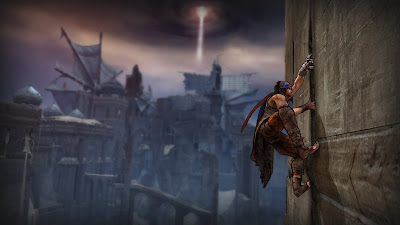
The prince is good at climbing. This is a good thing, 'cause there's a lot of it.

The prince’s new rough-and-tumble look is only part of the equation, however. Although handy with a sword, his combat skills are tempered by the presence of Elika, a devoted princess (and priestess) who wields magic powers against the ‘corrupted,’ demon-like beings who pledged their loyalty to the dark god, Ahriman, who is (sort-of) let loose from his prison at the beginning of the game.

Together, Elika and the prince must cleanse the corrupted lands of…wherever they are, and when not effortlessly swinging and clambering across gorgeous landscapes, they're forced to face off in a series of heavily-cinematic battles with Ahriman’s would-be brood in order to save Elika’s nigh-abandoned kingdom.

Combat has also been modified and tweaked in the new Prince. Far more artistic than technical, there are only two attack types (gauntlet and sword), acrobatics and Elika’s magic. The result are often-climactic, film-like deathmatches that show the prince and his companion in various dazzling acrobatic signatures which highlight the game’s stunningly stylized art direction.
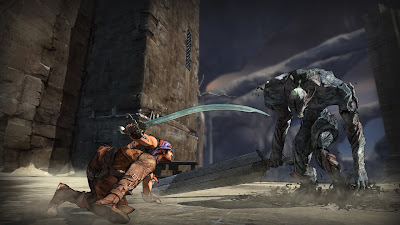

Unlike it's predecessors, combat in Prince of Persia is a one-on-one, cinematic affair.

So, if you’re expecting to find an evil vizier in this Prince of Persia, you won’t.
Call it the Batman Begins of the gaming world—And like Christopher Nolan’s take on the Dark Knight, Ubisoft Montreal’s recreated prince is emblematic of just how much everything old is new again in this game.

It’s actually a near-completely different interpretation of the series, similar in some respects to when Japanese director Ryuhei Kitamura reimagined Hideo Kojima’s PS one classic Metal Gear Solid in the Gamecube’s MGS remake The Twin Snakes (although a bit more drastic).

But unlike The Twin Snakes, which could have been called “Metal Gear Solid: Ridiculous Action Movie,” (a jab I make lovingly—games wouldn’t be the same today without Kojima’s precedent-setting series) Prince of Persia may actually be something else entirely: an “art” game.

Take, for example, Elika. Her presence seems to draw some vague parallels to Sony’s PS2 title ICO, which paired a hero (a little boy with horns) with Yorda, a defenseless princess, on a quest to escape a mysterious castle.

Despite its fantasy setting, ICO feels and plays like an indie film (and rightly so, considering the game has been lauded for its unyielding originality, and many feel it’s responsible for starting the whole ‘games as art’ debate). And while Elika is an actual asset in battle, Prince of Persia doesn’t exactly feel like your run-of-the-mill adventure game, either.
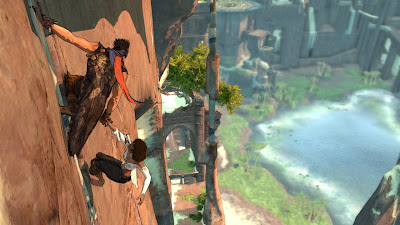
The prince and Elika's travels take them through beautiful, lush environments.

The game actually has more in common with Shadow of the Colossus, Team ICO’s “boss-battle-only” spiritual successor-cum-quasi-prequel to ICO—also added to “art game” canon because of its unique combat structure.

Like Colossus, fighting in the new Prince amounts a series of simply-controlled, one-on-on boss and mini-boss battles that pit the prince and Elika against the guardians (as well as the occasional minion) of each of the game’s distinct, open environments, whose areas become more accessible as you progress.

Also like Team ICO's god-killing masterpiece, Prince of Persia’s open-ended world is vast and beautiful, although you won’t be felling monstrous beasts on horseback. Instead you’ll be spending most of your time traversing across an increasingly vertical world, whether you’re exploring, talking with Elika or healing corrupted lands, in a mix between adventure game exploration and straight-up platforming.

But perhaps the biggest thing about Prince of Persia which is suggestive of “art game” status is that you can’t die. Every time you fall down an endless chasm or are about to feel the rough blade of a corrupted in your chest, Elika’s mysterious light-based powers intervene.

In theory, this isn’t really that much of a departure from most any other game—you make your way through the game, fall down a pit, get attacked by a monster, are shot up by terrorists, whatever—after game over, you either start from a checkpoint or a savepoint.
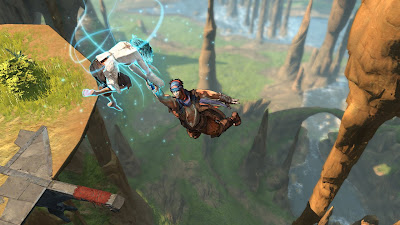
Without Elika, the prince would be dead. A thousand times over.

It’s understandable why some might throw up red flags over my claim that a Prince of Persia could really be an “art game” to stand shoulder-to-shoulder with Team ICO's efforts or those of Killer 7 creator Suda 51. To some degree, I wonder how it could be possible, too.

But hear me out: it's all in the game’s approach. Since the prince can't die, you can’t lose. And if you can't lose, the developers were obviously hoping gamers would find another emphasis on something other than the challenge.

Luckily, there’s myriad parts of the game with which to distract you. Gameplay is smooth, the world sumptuous and absorbing, and its unique mechanics, with a focus less on crossing blades than on running across cliffs and leaping over chasms make for an exciting time.

The prince himself is well developed, swashbuckling, and unlike his predecessors, often laugh out loud funny—particularly during in-game banter sessions you can choose to have with Elika (which makes sense, given that his vocal cords are supplied by none other than Nolan North, who brought Nathan Drake to life with same smart-ass personality in PS3’s Uncharted: Drake’s Fortune).

The game’s script often has the spirit reminiscent of the original Pirates of the Caribbean, complementing the new Prince’s high-end production values, its gorgeous cel-shaded character models and the wonderfully organic world rendered around them. The result is a game brimming with humor and heart.
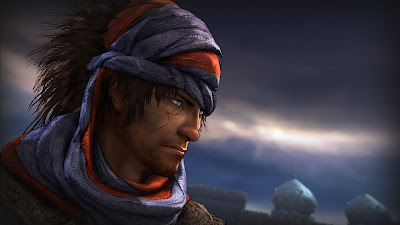
Clearly, the prince has been through a lot. And he's got a smart mouth, to boot.

Ubisoft Montreal are also clearly a bunch of cinema lovers, which is evident in more than just the combat. Watching Elika cleanse the corruption from filthy, polluted wastelands into brightly lit, lush, colorful landscapes is a major visual treat that show off the game’s technical prowess and artistry, as are some of the game’s epic setpieces. Both bring to mind the kind of unique vision and execution of rousing adventure films.

Would the old prince ever have been able to springboard through the sky between giant globe-like flying machines ripped from the imaginations of Jules Verne and Tim Burton? I don’t think so.

However, as fun as the new Prince is, it isn’t perfect. Some players may find it hard to subscribe to the game's no-death philosophy, and others may be turned off by its “tap a button”-style combat and the general ease given with essential immortality.
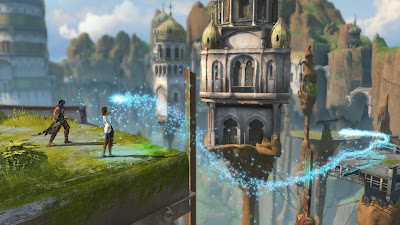
Healing corrupted lands is just one of the many unothordox things you'll spend your time doing.

In it’s own way, Prince of Persia does still feel like you’re living out an ancient legend, albeit one that displays a different kind of storytelling than in The Sands of Time. But if art is defined as “thinking outside the box” then Prince of Persia is certainly worthy of such a description.

Like Master and Commander: The Far Side of the World, which Russell Crowe once called “an arthouse movie with a big budget,” the gameplay in Prince of Persia isn’t your typical mainstream industry fare. Hell, the villain isn't even really present, aside from being a much talked about malevolent force.

There are snatches of industry standards, to be sure, but what Ubisoft Montreal has really done is taken the series, stripped it down to its bare essence, and rebuilt it from the inside out with a new, completely different body.
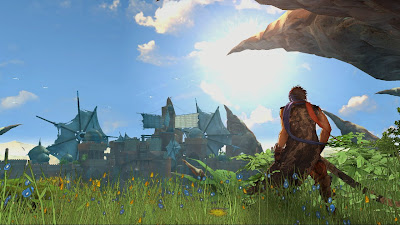
When not dealing with dark gods, the prince enjoys quiet walks in the countryside.

True, without the promise of death, the presence of real tension in the game is questionable, but maybe it’s not the point, either. If more games would take more risks like this, video games could very well develop into the same kind of multifaceted medium that film industry has become.

And if Ubisoft can do it to the new Prince, an unabashedly high profile game which wears its budget on its sleeve, maybe more companies should be able to take such chances. It’s likely that's precisely the message the game is trying to get across, otherwise such drastic changes probably wouldn't have made it beyond the stage of concept art.

It’s rare that art games move that many units, but it doesn’t make them any less important—such may well be the case with this game.

So, will the industry listen? Only time will tell. But even if Prince of Persia isn’t perfect, it too is important. It's bold and brassy, and most notably, tries something different. Do yourself a favor—don’t ignore this one.

Prince of Persia
4.5 out of 5 stars
Ubisoft
PS3, Xbox 360
$39.99


  • Princely quips

    The prince definitely has a way with words, as is clearly seen in his conversations with Elika and elsewhere in the game. Here's some of our favorites:

    P: - "Ugh! I was on my way home. I had more gold than you could--I'd'a had wine! Women! I'd had carpets this thick!"

    P: - "Hey, you're cute, but not 'stay and fight a dark god' cute."
    E: - "Would you have helped my father if he had asked you?"
    P: - "He's not that cute, either."

    P: - "Anything else you think you should be telling me?"
    E: - "You're an idiot."

    P: - "I like your top."
    E: - "I think I have a spare if you'd like it."

    E: - "Just be patient. Patience brings rewards."
    P: - "So does walking into a harem covered with chocolate."

    P: - "Do you often go falling out of the sky on to men? I mean, you're a good-looking girl and all...obviously pretty high maintenance, but you shouldn't need to go dropping out of the sky on to men."

    P: - "Do corruption stains come out?"
    P: - "Gods, monsters, crazy women...what's the difference?"
    P: - "Run, jump, die, repeat. Run, jump, die, repeat. I'm starting to get the hang of this!"
    P: - "She's not my girlfriend, she's my donkey."

Sunday, December 28, 2008

Banjo-Kazooie’s latest outing throws a wrench in the works

I don’t envy Banjo and Kazooie. After only defeating witchy villainess Gruntilda a handful of times in Banjo-Kazooie games over the past decade, the duo have fallen into lethargy, fattening up with a perpetual routine of video games and pizza—at least according to the conceit that begins their newest adventure, Banjo-Kazooie: Nuts & Bolts.

Nuts & Bolts
establishes the now retired duo living lazily at their home in Spiral Mountain, which makes sense since they haven’t had a proper console adventure since the heyday of the N64. And when I say lazy, I mean it—bear and bird have become so out of shape that Banjo now sports a hefty, blubbery gut, and Kazooie can’t even fly.

This may seem a slightly bizarre approach to begin a new long-overdue installment of a successful platforming series, but Nuts & Bolts isn’t your typical platformer. Rather than simply giving Banjo and Kazooie an HD facelift and a new world to play in, developer Rare opted to go for something else entirely with Nuts & Bolts: a self-aware platformer with vehicular gameplay.

So, whereas you’ll still be collecting tokens, notes (the game’s currency) and Jiggies—Banjo’s equivalent to Mario’s stars—in Nuts & Bolts, you’ll mostly be doing so in land, water and air-based crafts you build yourself. That being said, this isn’t strictly a racing game. There are plenty of races, sure, and most every challenge in the game is timed, but there’s the game’s vehicle building and platforming mechanics make it more of a hybrid.

Nuts & Bolts' whimsy even spills over into its aesthetic style.


Game self-awareness on the level of Nuts & Bolts' is something of a rarity in the industry. Although it may just look and feel like a kid’s game at first, the game’s sharp writing makes use of every opportunity to take jabs both at itself and the game industry in general, with plenty of sarcasm and self-reflexive humor.

This is clear from the very start, when the Lord of Games, or L.O.G., shows up and actually pauses the game, stopping a fight that’s about to break out between Banjo, Kazooie and old Grunty’s head, which has reappeared to hound the duo.

“Greetings, second-rate game characters!” L.O.G. greets the trio.

If Nuts & Bolts’ intro, which makes fun of platforming conventions and plot devices is anything to go by (and it is) the game is rife with parody. After L.O.G., the creator of all games, forces Banjo and Grunty to race collecting as many pointless game objects as possible, (a genre convention most gamers will recognize instantly) it magically makes Banjo and Kazooie fit again and gives Grunty back her body.

When Kazooie protests that she no longer has any of her old moves from previous games, L.O.G. dismisses them as ‘outdated’. Finally, bear, bird and witch are forced to follow L.O.G. on vehicles, of which will transport our heroes throughout the game’s world, Showdown Town.

Like previous Banjo adventures. (or most platformers since Super Mario 64) Showdown Town serves as a hub from which the game’s levels can be accessed, challenges taken on and jiggies obtained. To do so, you’re given a bucket of bolts that vaguely reminiscent of a shopping cart to get around in.

For a platformer, Showdown Town is massive, with various districts and distractions and townsfolk (including familiar faces like Mumbo Jumbo, the series shaman who now owns a garage) to talk to, and thanks to Nuts & Bolts’ uber-slick, cartoony aesthetic you feel like you’re driving through a living, breathing place, like something out of a Shrek­-type CG film.

Although you’ll want to stick to your vehicle most of the time, bear and bird can still perform a few basic functions.

This time around, Kazooie is restricted to simply using a helpful magical wrench, which can pick up objects, turn over vehicles, and perform automotive adjustments on the fly, thanks to Nuts & Bolts’ use of the item manipulation friendly Havok engine, and Banjo can still…uh, run around, jump and swim.

Once you leave the town and enter a level, however, you aren’t restricted to your metal-box-on-wheels when selecting a vehicle to traverse the game’s gorgeous environs.

Gameplay herein involves finding and accepting challenges, activated by talking to new and returning characters in the levels. Winning challenges in turn nets you more jiggies, which are used to unlock new levels.

Challenges come from in a variety of forms, ranging from something simple, like racing someone around a route made into the level, hard, like protecting a helpless character or location from hordes of Grunty’s new malevolent grunt-bot henchmen, or ridiculous, like hard-boiling a giant egg by transporting it into an active volcano.

Occasionally Nuts & Bolts forces you to use a vehicle designed for a particular task, but most of the time, you have free reign over what mode of transportation you pick. Collected notes can be used to buy new vehicle parts and blueprints, which brings us to the game’s most fun feature: its robust vehicle editor.

Nuts & Bolts
’ open-ended design lets you change, modify, or completely scrap vehicles to build something new. And although creating a running vehicle could sound daunting to non-gearheads such as myself, the process has been streamlined for gamers of any age.

Whether you’re building from a blueprint or starting from scratch, the process is simple—lay down the basic components in your rotatable workspace and the editor will display each part in green, red or yellow if the vehicle’s components will or won't work together, or if something’s missing.

The game’s varying challenges make modifying and creating new vehicles necessary, but the trial and error process is also a lot of fun. Until you get a basic grasp of weight, physics and part stats, you’ll probably be laughing at yourself over some of your results.

Finally, when you think you’re all set for a level, you can test out your contraption using the game’s in-garage test course. The ability to access Mumbo’s garage in Showdown Town before starting any challenge is also a welcome feature, which makes performing vehicular tweaks a breeze, and saves you from the tedium of driving back to the garage or entering a level to test out your new creation.

As you progress in the game, you can work your way up from basic cars to anything from a series of connected cars that look like a centipede to jumping, four-wheels cube covered in weapons—simply put, the only limit to how ridiculous you can make something is your imagination, so long as you have the necessary parts.

And much like the game’s whimsical aesthetic, the aforementioned humor is everywhere. Much like the mission structure in open world games like No More Heroes and Grand Theft Auto, Nuts & Bolts eschews a deep narrative for a script that mostly involves conversations with characters presenting challenges, but its still often pretty funny.

Although in previous games Kazooie has been the cynical one, in Nuts & Bolts, both she and Banjo have become pretty jaded, and are well aware when they’re being asked to participate in a useless fetch quests or menial tasks to the point where the two often chastise or make fun of characters who seem less aware of their own game-based existence.

Constant in-jokes and references also pop up frequently, in levels like Banjo-Land, an amusement park-like area themed after locations from previous Banjo adventures, (now presented as a museum), and LOGBOX 70, which is basically the inside of a giant Xbox 360, complete with spinning game discs of old Rare titles.

Familiar themes and the series’ trademark unintelligible-animal-noise “voice acting” are present as well, and Nuts & Bolts even breaks the fourth wall by having elements the game admits were cut from the final release appear in cameos (read: inflatable sheep), making this one a much smarter game than you might assume from the constant presence of a dopey-looking bear.

Aside from the game’s great sense of humor and creativity, though, Nuts & Bolts does have a few loose screws. For one, the game’s challenges range greatly in difficulty, and, much like any game with racing elements in it, computer controlled characters cheat from time to time.

On top of that, some vehicles’ controls are way too sensitive—to the point where one turn taken slightly the wrong way will result in a series of unwieldy turns or circular spins, which, in a timed-based event against perfect CPU opponents is often the kiss of death.

But the most disappointing thing about Nuts & Bolts is that its creative mechanical design and clever sensibilities don’t always follow-through in the game’s challenges, which are usually little more than races, escort services, attack or defend scenarios, or item fetch quests. Given the sheer amount imagination in the rest of the game, it seems an almost criminal misstep that more inventive tasks weren’t used, and can make the game feel more frustrating than it should.

While this isn't a make or break deal, it is worth noting—the game certainly wouldn’t be any worse with more platforming elements and more varied tasks for vehicle use. Surprisingly, it doesn’t ruin the experience, and for what it does, the game does pretty well.

Nuts & Bolts
may not be for everyone—the vehicular mechanic is far more than a gimmick, but it’s the kind of thing you’ll either love or hate. Regardless, Rare took a big chance with the game’s mechanics, and its innovation and reflexive nature is exactly the kind of forward thinking the industry needs, even if Nuts & Bolts’ level design could have used a little more time under the hood. Whether you’re a gearhead or are just looking for something different, this one puts the screws to the competition (sorry, I couldn’t resist). Check it out.

--

Got a problem with this review? Want to get into an argument over pointless gaming knowledge? Leave a comment below!